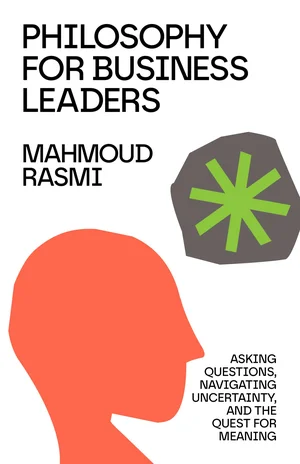
Philosophy for Business Leaders
A philosophical mindset for when there's no clear path forward.
About the Book
Expertise has almost become synonymous with certainty, knowledge, and definitive answers. We live in a world where everyone is expected to know what they're talking about, make the right decisions, and be effective in their pursuits.
A direct consequence of this is the discouragement of asking questions, sometimes leading to an increasing sense of impostor syndrome, while at other times, resulting in a lack of self-awareness and an acute sense of alienation at work and in life.
But is there another way, one that perhaps values curiosity, belief questioning, and uncertainty?
This book suggests that a philosophical mindset may offer a possible remedy to this problem. It does so by exploring the importance of asking questions, questioning our assumptions, embracing and navigating uncertainty and adversity, and finding meaning in them, as well as exploring ethical decision-making frameworks.
Read a sample →What Readers Say
"In this engaging volume, Mahmoud Rasmi brings philosophical ideas to decision-making in business and everyday life. Relatable and often lighthearted, this book is sure to give everyone an opportunity to pause and reflect on some of the more vexing choices we all need to make."
"In this book, Mahmoud Rasmi seamlessly blends the profound insights of philosophy giants such as Socrates, the Stoics, Immanuel Kant, and Viktor Frankl into practical roadmaps for success in the corporate world."
What's Inside
Examine & Question
Socrates built his entire method around not knowing. This part digs into why questioning our assumptions, about our decisions, our teams, our direction, is where clear thinking actually starts. Includes the Socratic method, perspective-shifting, and the art of asking the right question before trying to answer it.
Uncertainty & Meaning
The Stoics had a lot to say about what's in our control and what isn't. Viktor Frankl found meaning in the worst circumstances imaginable. This part takes their thinking into the boardroom and into the harder moments of any working life. How to navigate adversity without losing the thread of why it matters.
Ethics in Practice
Virtue ethics, consequentialism, deontology. This part applies each framework to concrete situations: how to handle an underperforming employee, what to do when our values and the company's don't align, where to draw the line when the rules don't cover it. For when there's no clean answer.
Table of Contents
- 1.Examine Yourself: Socrates
- 2.The Socratic Framework of Inquiry
- 3.Find and Embrace Your Inner Trickster
- 4.Shifting Perspectives
- 5.Navigating Uncertainty & Adversity
- 6.The Quest for Meaning
- 7.What is Ethics?
- 8.Virtue Ethics
- 9.Consequentialism
- 10.Theory of Duty (Deontology)
The Author

Get Your Copy
Whether you're facing a decision with no clear answer, managing through uncertainty, or working through an ethical question you're not sure how to approach, this book is the starting point.